
The Ultimate Guide to Growing and Caring for Horsetail Reeds
What You Need to Know About Horsetail Reed Care
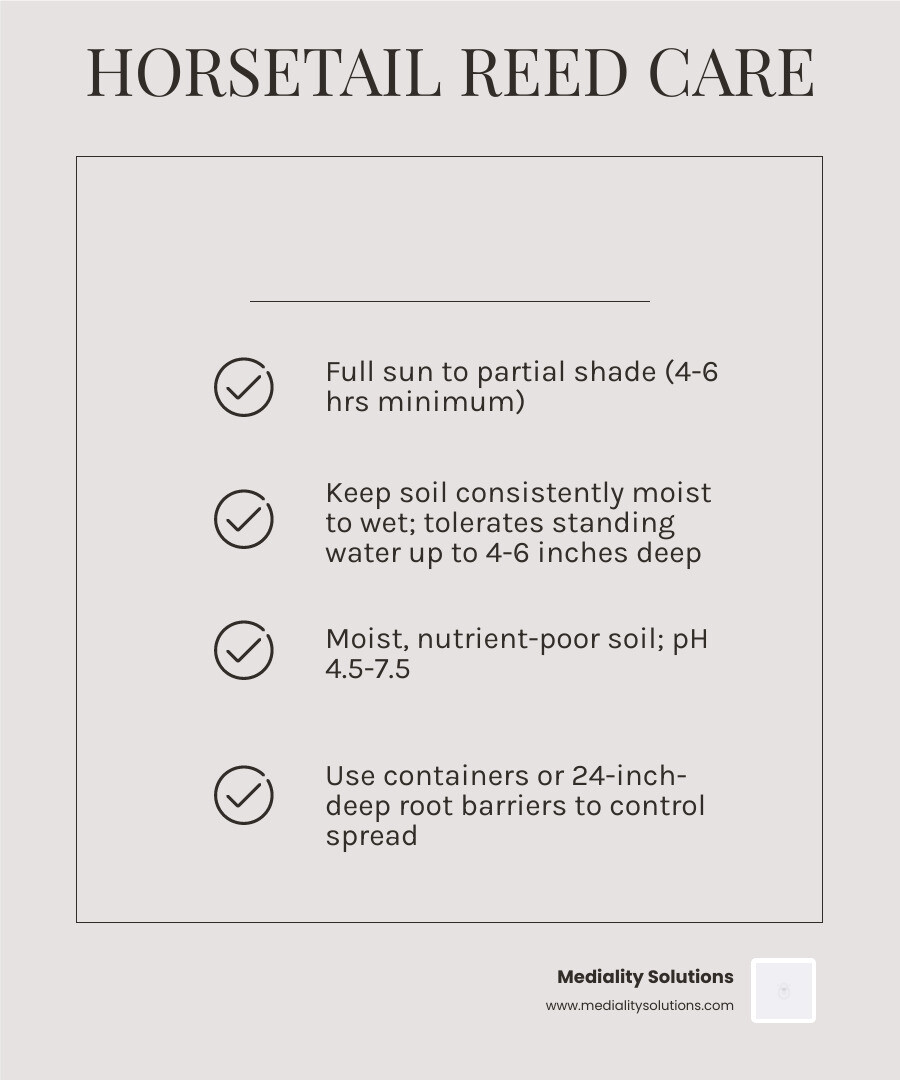
Horsetail reed care is surprisingly simple once you understand two things: this plant loves water, and it will spread if you let it.
Here’s a quick summary to get you started:
| Care Factor | What to Do |
|---|---|
| Light | Full sun to partial shade (4-6 hrs minimum) |
| Water | Keep soil consistently moist to wet; tolerates standing water up to 4-6 inches deep |
| Soil | Moist, nutrient-poor soil; pH 4.5-7.5 |
| Fertilizer | Generally not needed — can actually cause problems |
| Pruning | Remove dead or damaged stalks at ground level |
| Spread control | Use containers or 24-inch-deep root barriers |
| Hardiness | USDA Zones 4-10; very cold-tolerant |
Equisetum hyemale — commonly called horsetail reed, scouring rush, or rough horsetail — is one of the oldest plants on Earth. It has survived since the Carboniferous Age, roughly 350 million years ago. That prehistoric toughness is exactly what makes it both a dream plant and a potential headache for home gardeners.
Its tall, hollow, bamboo-like stems create a striking vertical accent in water gardens, pond edges, and boggy spots where most plants simply refuse to grow. It’s evergreen, low-maintenance, and deer-resistant.
But here’s the catch: horsetail spreads aggressively through underground rhizomes. Without the right containment strategy, it can take over your garden faster than you’d expect.
This guide covers everything — from ideal growing conditions to containment methods, winter care, toxicity warnings, and how to remove it if things get out of hand.
Understanding Equisetum hyemale: A Living Fossil
When we look at a patch of Equisetum hyemale, we are essentially looking back in time. As a member of the most ancient living genus of vascular plants, horsetail reeds dominated the landscape during the Carboniferous Age—long before flowers even existed.
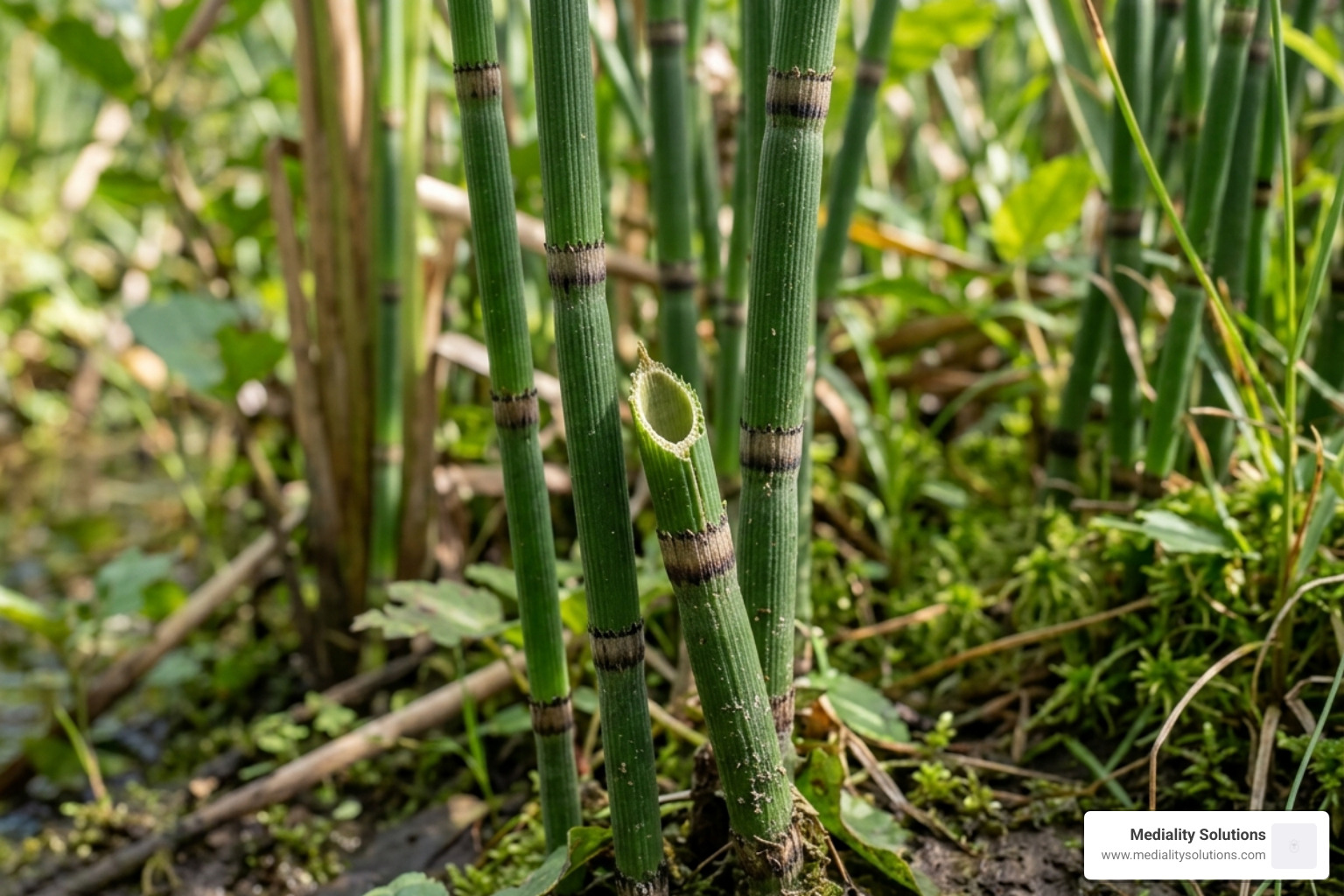
These plants are unique because they are non-flowering and seedless. Instead of seeds, they reproduce via spores held in pine-cone-like fruiting heads called strobili. The stems are the stars of the show: hollow, jointed, and ridged. These ridges are packed with silica crystals, which gives the plant its gritty texture and its historical nickname, “scouring rush.” Early settlers and indigenous people used these stems to scrub pots, pans, and even polish pewter and silver.
In terms of size, Equisetum hyemale (Horsetail) typically reaches a mature height of 2 to 4 feet, though some varieties can stretch up to 5 or 6 feet in perfect conditions. While it looks like bamboo, it is actually a distant relative of ferns. It is native across North America, Eurasia, and Canada, making it highly adaptable to various climates.
Essential Horsetail Reed Care and Growing Conditions
In our experience at Mediality Solutions, we’ve found that the key to successful horsetail reed care is mimicking its natural wetland habitat. As of April 2026, climate trends show more gardeners are turning to resilient, water-loving plants for rain gardens and urban landscapes.
Light and Temperature
Horsetail is incredibly hardy, thriving in USDA Zones 4 through 10. It prefers full sun to partial shade. In extremely hot regions, we recommend providing morning sun with afternoon shade to prevent the stems from scorching or drying out too quickly. It is also surprisingly tolerant of urban pollution, making it a great choice for city dwellers.
Soil and pH Preferences
One of the best things about this plant is its flexibility regarding soil. It isn’t picky, but it does have preferences for moisture retention.
| Soil Characteristic | Preference |
|---|---|
| Type | Clay, loam, sandy, or gravelly |
| pH Level | Acidic to neutral (4.5 to 7.5) |
| Nutrients | Prefers nutrient-poor soil |
| Drainage | Poor to moderate (tolerates waterlogging) |
Water Requirements
Water is the most critical element of horsetail reed care. These plants can grow in standing water up to 4 or 6 inches deep. If you are planting them in the ground rather than a pond, the soil must stay consistently saturated. If the soil dries out completely, the stalks will begin to droop and turn yellow.
Optimizing Horsetail Reed Care for Water Gardens
In water gardens or boggy areas, horsetail acts as a magnificent vertical backdrop. It absorbs nutrients directly from the water through its deep root systems, which helps keep pond water clear. However, as The Spruce notes, the aggressive nature of this plant means you should almost always plant it in submerged containers rather than directly into the pond substrate.
Soil and Substrate Requirements for Horsetail Reed Care
For those of us using containers, a mix of sand, gravel, and peat moss is ideal. Avoid using rich, high-nitrogen potting soils. In our DIY guides, we often suggest a 1:1 mix of sand and loam. Peat moss is particularly helpful if you need to lower the pH of your soil to reach that preferred acidic range.
Planting and Containing Aggressive Rhizomes
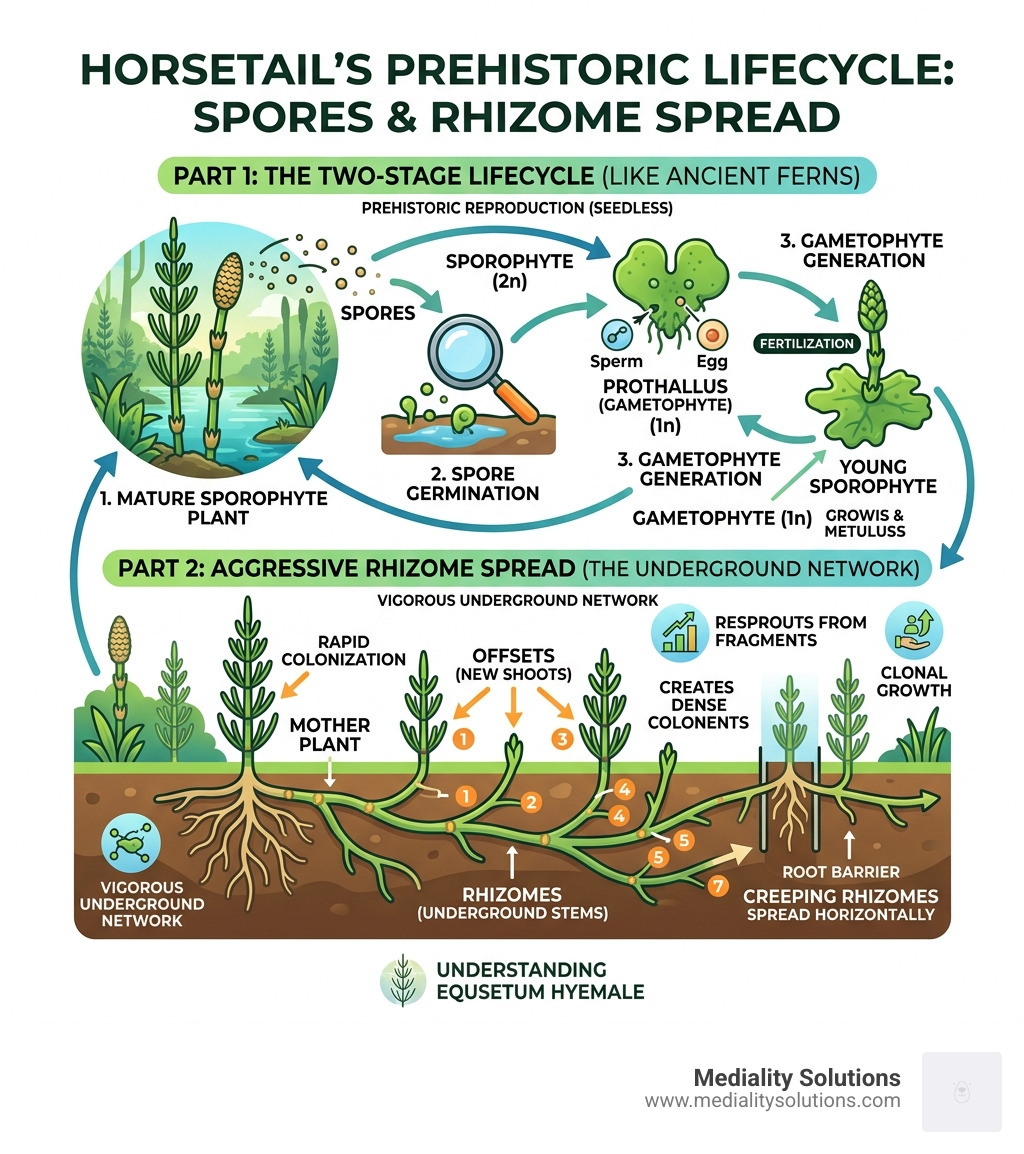
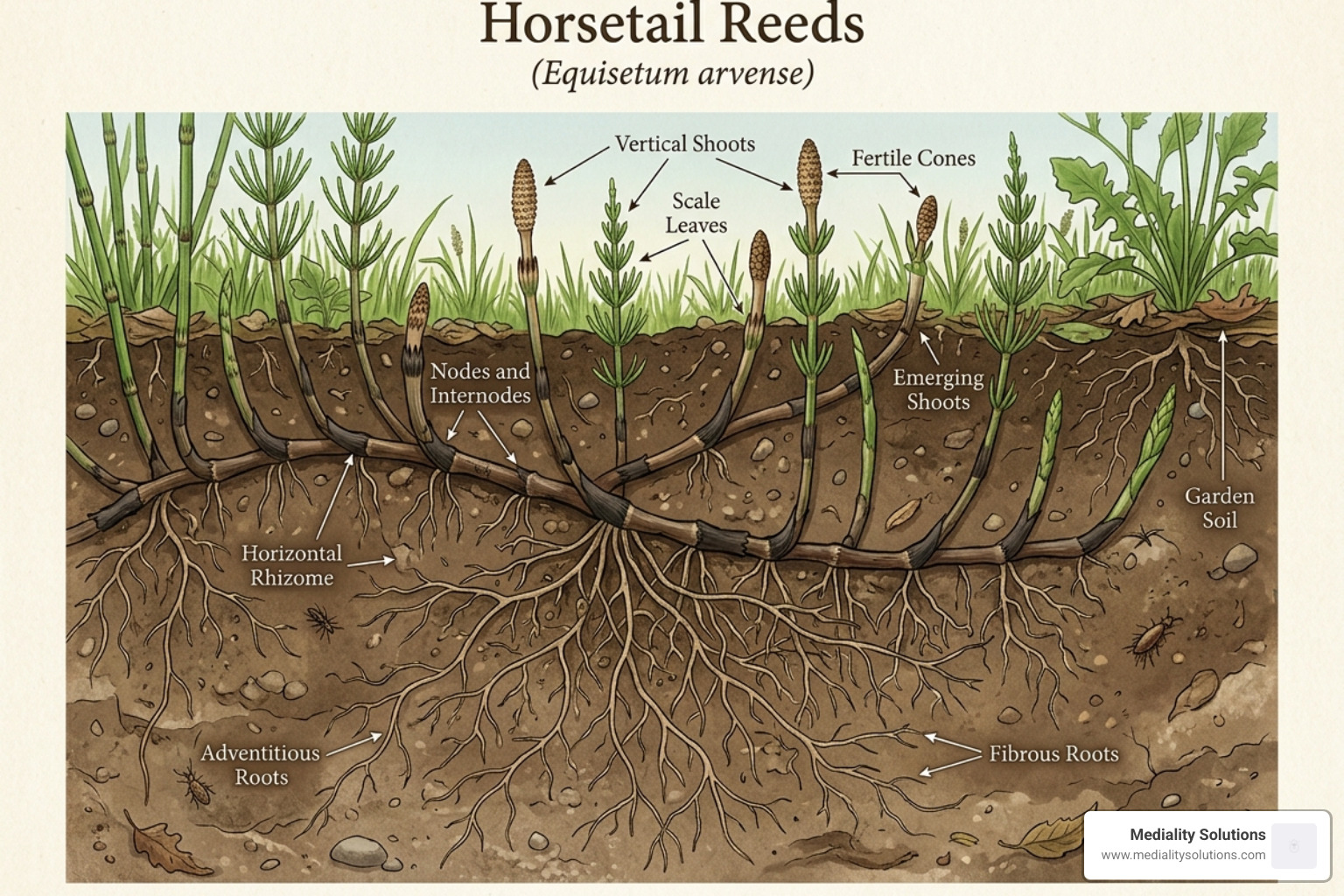
The biggest mistake gardeners make is underestimating the rhizomes. These underground runners can travel deep and wide, popping up feet away from the original plant. They can even grow under sidewalks or driveways!
Containment Strategies
To keep your garden from becoming a horsetail forest, we recommend these containment methods:
- Physical Barriers: If planting in the ground, install a 24-inch-deep plastic or metal root barrier. Leave about 2 inches of the barrier above the soil line to prevent the rhizomes from “jumping” over the top.
- Container Planting: This is our favorite method. Plant the reeds in deep pots (18-24 inches) with no drainage holes, or sink the pots into the ground.
- Spacing: When planting for a screen, space your clumps about 6 to 12 inches apart. They will fill in the gaps within a single growing season.
Methods for Ground vs. Container Planting
When planting in containers for a deck or patio, ensure the pot is wide enough (at least 24 inches) to prevent the plant from becoming root-bound too quickly. For a modern, architectural look, rectangular planters are excellent for creating privacy screens. Just remember to keep them plugged to hold water!
Maintenance, Pruning, and Seasonal Protection
Maintenance for horsetail reed care is generally low, but a little attention goes a long way in keeping the plant looking its best.
Watering and Fertilizing
If your horsetail isn’t in a pond, water it daily. A good rule of thumb is to ensure it receives at least 1 inch of water every other day. Regarding fertilizer, less is more. We recommend a balanced 10-10-10 slow-release fertilizer in early spring only if growth seems stunted. Over-fertilizing can actually encourage the plant to become even more invasive.
Pruning Techniques
You don’t need to prune for shape, but you should remove any dead, damaged, or brown stems. Always cut at ground level. If you snip the top of a stalk, it will branch out and become top-heavy, which ruins the clean, vertical aesthetic.
Winter Care
Horsetail is an evergreen perennial and is remarkably cold-tolerant, surviving temperatures as low as -20°F. In harsh Zone 4 or 5 winters, the stalks may turn brown or experience some dieback. You can insulate the base with marsh hay or mulch to protect the rhizomes. In the spring, simply clear away the old mulch and any dead stalks to make room for new growth.
Troubleshooting: Pests and Yellowing
While generally pest-free due to its high silica content, you might occasionally see aphids or spider mites. A quick spray of neem oil usually does the trick.
- Yellowing: This is usually a sign of iron or nitrogen deficiency, or a signal that the plant has finally dried out.
- Drooping: This is often caused by wind damage or underwatering.
Toxicity and Safety Warnings
We must emphasize safety: horsetail is toxic to livestock. It contains an enzyme called thiaminase, which breaks down Vitamin B1 in the body. This is particularly dangerous for horses and cattle, leading to weakness and loss of coordination. It is generally not considered a major threat to cats or dogs unless consumed in massive quantities, but it’s best to keep pets away. Also, the stems are abrasive—wear gloves if you have sensitive skin!
Conclusion
At Mediality Solutions, we believe that every gardener can enjoy the striking beauty of Equisetum hyemale if they respect its power. By using containment barriers and maintaining consistent moisture, you can harness this “living fossil” to create a stunning, low-maintenance landscape.
If your horsetail has already staged a coup in your backyard, here is how to take it back:
- Manual Removal: Dig up the rhizomes. You must get every piece, as a single fragment can regrow.
- Starvation: Cut green shoots as soon as they appear for 3-4 years to starve the root system.
- Chemical Control: For severe infestations, herbicides containing triclopyr or glyphosate can be used. We recommend “bruising” or stepping on the stalks before spraying to help the chemical penetrate the silica-rich exterior.
Is Horsetail Reed invasive in all climates?
In temperate zones with plenty of moisture, yes, it is highly invasive. Some states like Oregon, Washington, and California have specific restrictions or warnings regarding its use near natural waterways because it can outcompete native species.
Can I grow Horsetail Reed indoors?
Yes! It makes a fantastic indoor plant if you provide bright, indirect light and keep the soil “swampy.” Use a pot without drainage holes and mist it occasionally to maintain humidity. It won’t grow as fast as it does outdoors, but it remains a beautiful architectural piece.
How do I propagate Horsetail Reeds?
Propagation is easiest by division. In the spring, use a sharp spade to slice a section of the rhizome clump. Ensure each piece has at least one healthy rhizome and a few green stems. Replant it immediately at the same depth, and it will take off in no time.
For more DIY herb guides and sustainable gardening tips, visit Mediality Solutions. Happy gardening!
